|
Dancehall Vs. Roots: Reggae legend tells why there is a place for both |
|
|
|
|
|
|
Written by Words by Bret Lueder
|
|
Tuesday, 22 July 2008 |
|
|
|
|
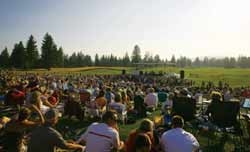
The Truckee Reggae Festival is this Saturday, July 26 starting at 4:30 p.m. (doors open at 4 p.m.) at the Truckee Regional Park Amphitheater where Pato Banton with Mystic Roots Band will be headlining a stellar bill including President Brown, Del Castillo and Salvador Santana.
Whether you like “dancehall” reggae or you like “roots” reggae, British-born reggae superstar Pato Banton says that there is a place for both kinds of music.
If roots reggae is reggae music which utilizes spiritual “riddims” and positive lyrics, often times about alternative history, political justice and Jah (God), then dancehall has been stereotyped as the opposite.
So the two camps have taken verbal shots at each other for decades now. Ardent roots reggae fans, sometimes called “purists” either by themselves or by dancehall fans sarcastically mocking their seeming arrogance, complain that dancehall too often has negative lyrics that degrade women, promote the usage of drugs and/or violence and does more psychological damage to the youth than it does good by entertaining them. The beat is faster and more emphasis is placed on the flashy images that the artists are portraying, not on any kind of subject matter with any substance, say the roots reggae fans.
But the dancehall fans charge that singing about the roots is boring and is for old people. Also, that the over-emphasis of particular riddims—especially the Nyanbinghi, or heartbeat riddim-- is too repetitive. Besides, they say, roots reggae purists are too snooty to know how to have fun. Will there ever be acceptance between these two reggae music factions?
I was able to talk with Banton about these two seemingly disparate groups, among other topics, in a recent telephone interview from his home in southern California. Banton was born “Patrick Murray” in 1961 in London. His teenage years found him right smack-dab in the middle of a British music explosion in his hometown of Birmingham where he grew up. By the time he was a teenager, Black Sabbath had already been rocking for a decade or more and the punk and reggae scenes in England were just about ready to fuse into what would become the British ska movement in the late ‘70’s and early ‘80’s as chronicled in music history books.
He was fronting the roots reggae band Crucial Music by the age of 19 and had an early reputation as a formidable MC, which is more like a rapper than a singer. But “Banton,” which means “heavyweight lyricist,” embraced many kinds of music. While always willing to dabble with the roots and the heartbeat riddim, he was also willing to express himself through dancehall, ska or “Whatever,” he said, “It just didn’t matter. I wanted to express myself in every way possible.”
His talents have enabled the singer to work and perform with the likes of The Beat (formative British ska band), UB40 (British reggae band) and even Sting who has dabbled with the reggae beats while fronting The Police.
Pato Banton proves that you don’t have to be a Rastafarian to endorse the roots and that you don’t have to have dreadlocks to be Rasta. So why not have a place for both roots and dancehall reggae?
Bret had the chance to get in touch with Pato, check out this Q&A:
Tahoe World: Your music crosses over from roots to dancehall? They don’t appear to be able to mix.
Pato Banton: Yes, my music definitely does cross over. My roots are as an MC so my home should be the dancehall. But I am an artist who is into the roots and other crossed-off areas.
Tahoe World: So some of the roots “purists” say they don’t like dancehall because the lyrics are too watered-down or maybe some of the artists rely on negative messages of abuse to women or with drugs or “slack” words. But it still seems possible that dancehall can come from a positive place. Do you agree? Pato Banton: Yeah. And it depends on whether you take dancehall as a mentality or a style of music. So a dancehall beat is more of an up-tempo reggae beat just like ska is also derivative of the reggae/Caribbean beat. It is an up-beat instead of a down-beat. It’s really just a style of music. I guess it’s because dancehall has the ability to get people moving on the dance floor, it was used more often by the dancehall artists that use negative connotations in their lyrics. But as a style of music dancehall can be used as a roots form of expression if the artist is delivering the roots vibration with a consciousness vibe. It’s not the music that should be judged but what the artists are saying that should be judged.
Tahoe World: You grew up in Birmingham during the time of a huge creative musical explosion in the mid-to late ‘70’s. Where do you fit in amongst all of that history? And how did that experience influence you?
Pato Banton: Well I was a part of all that. It was a time when people were coming together. It was a time when the punks were coming out with a revolution and it was a time when there was racism in government. But there was also racial unity happening and blacks and whites were coming together to create ideas and music; and work together. But there was a lot of racial tension which drove a lot of the artists to embrace Rastafari and reggae music and come out with great messages. So I was right there, I was a part of it. I was as much a part of the British culture as I was a part of my Jamaica heritage (his father was a Jamaican DJ/sound system operator). But as the music was coming in from Jamaica and the British music scene was developing, we had artists like The English Beat, The Specials and Steel Pulse among a lot of others. There was just a lot of bands that were coming together using music as an expression. I had my own band at the time called Crucial Music and we were a very, very serious roots band. This was back around 1980. Back then I would tour with the roots band during the week and MC over my Dad’s sound system during the weekend. So I was able to mesh both styles. Now this became an issue with reggae purists who thought I should choose to be a singer and not an MC. Another issue the purists have had with me is that I wouldn’t stick to playing one style of music. I would go from roots to dancehall to ska and then hip hop because that was what was right in front of me. And I want to express myself in every way possible. You will get a full spectrum of music and vocal styles when you come to one of my shows.
Tahoe World: One of your popular songs off of arguably your biggest album to date, ‘88’s Never Give In, is called “Gwarn.” I’ve always wondered, what does “gwarn” mean? Pato Banton: Gwarn is basically a Jamaican word of encouragement. My Mum used to use it with me all the time when she would say, “Gwarn and go out there” or “Gwarn, you can do it.” I have since rerecorded a version with lyrics dedicated to my Mum. But yeah, it is a word of encouragement.
Tahoe World: Mystic Roots Band is originally from Chico, California. They will be playing with you at the Truckee Reggae Festival this Saturday. I’ve noticed that you have toured with them recently. I know they were good when I last saw them in Chico a few years ago. But just how good is Mystic Roots Band now?
Pato Banton: (He laughs for a few seconds) They are awesome! They are really awesome. They are as good as any other reggae that I have ever worked with. And I have worked with them all. I’ve worked with Steel Pulse. I’ve worked with The Wailers. I’ve had the I-Threes back me on a tour. I’ve worked with Third World and many, many other reggae bands in Jamaica and trust me, the Mystic Roots Band is just coming into their zone right now. They are just getting into their groove. And when you hear them bro’…Maaaan…Just awesome. They are actually my official band and we are partners now. And we intend to tour together for the foreseeable future.
Only registered users can write comments. Please login or register. Powered by AkoComment 2.0! |
|
Last Updated ( Tuesday, 22 July 2008 )
|
|

|